

Retention Periods
Retention periods determine how long we keep a customer’s personally identifiable information (PII) before it is purged. Purging doesn’t delete the underlying event record. It overwrites the PII with random data, prefixed with “Purged”, so the event trace remains for auditing while the personal data is removed. We apply four default retention periods, each covering a different type of customer: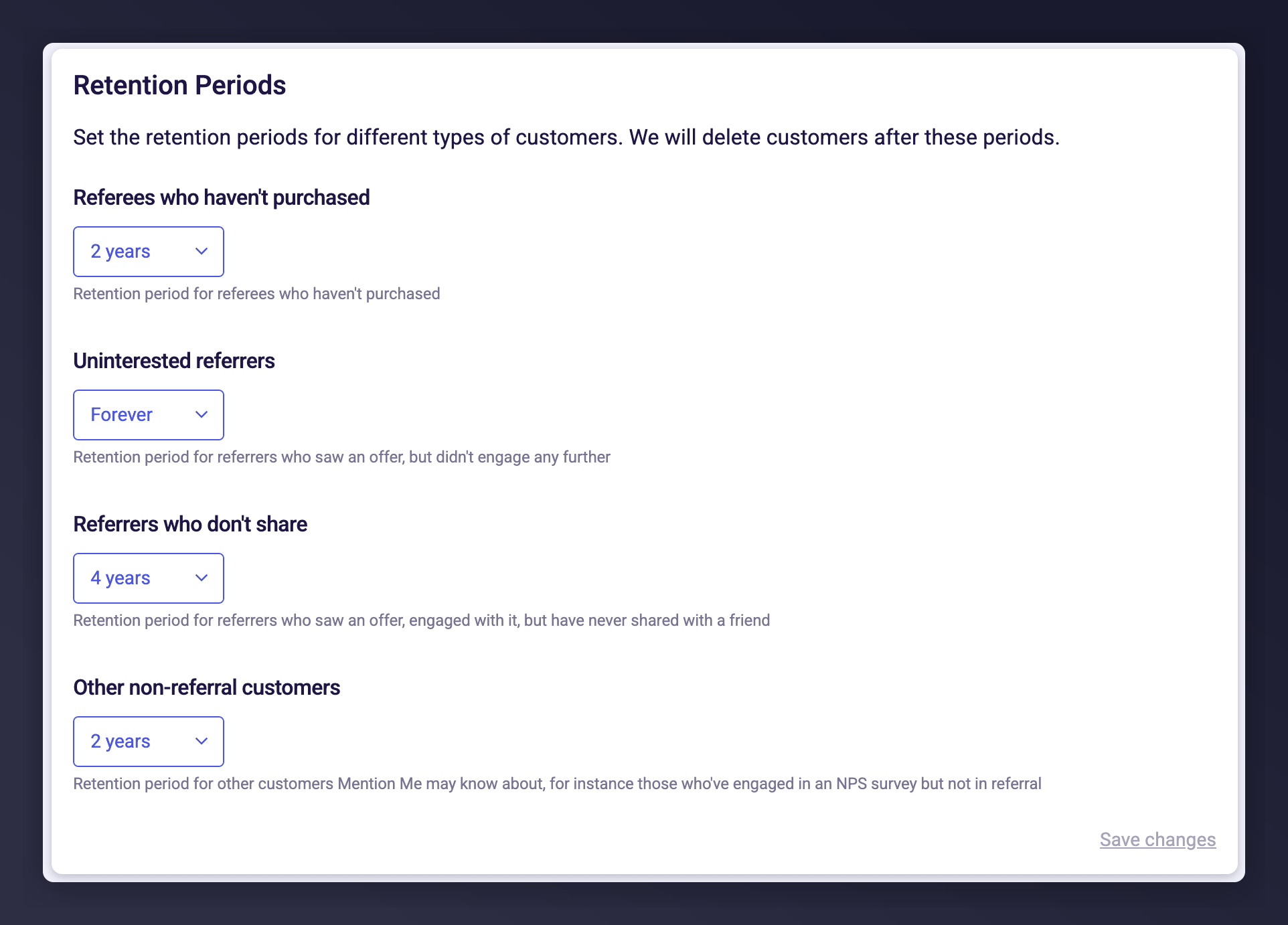
The Retention Periods settings page showing the default period for each customer type.
Why These Periods Were Chosen
The 2-year and 4-year defaults are based on aggregated sharing and purchasing behaviour across our client base:- Referral is a comparatively slow channel: only 59% of shares happen within the first 3 months of enrolment, rising to 89% by 24 months and 96% by 36 months. It takes 48 months to reach 98%. This is why the default retention period for referrers who don’t share is 4 years.
- Similarly, it takes around 2 years for 98% of referees who’ve been given an incentive to make their first purchase, which is why the default retention period for referees is 2 years.
Requesting a Change
You can override the default retention periods if needed. If you’re an existing client, speak to your Client Success Manager. If you’re a prospective client, speak to a member of our pre-sales team, and we’ll configure this during onboarding.This retention data can also be a useful reference if you’re compiling your own Data Protection Impact Assessment (DPIA).
Reactivation
Without reactivation, a customer who hasn’t purchased in a long time can never be referred again by friends or family, even though they’re technically still an existing customer. This means any potential for that customer to re-engage through a referral is lost. Reactivation solves this by treating a long-inactive customer as if they were new. Once a customer hasn’t purchased within the reactivation period, their friends can refer them again, giving the brand a way to re-engage dormant customers and potentially win back a lapsed relationship. For example, a customer who made several purchases around five years ago but hasn’t transacted since would, without reactivation, be permanently excluded from being referred again. With reactivation enabled, that customer becomes eligible to be referred once more after the reactivation period has passed.Default Reactivation Period
By default, reactivation is set to 12 months: a customer becomes eligible to be referred again once 12 months have passed since their last purchase. You can adjust this period to suit your business, in whole months from 1 to 240 (for example 12, 18, or 36 months). Setting the value to 0 disables reactivation entirely.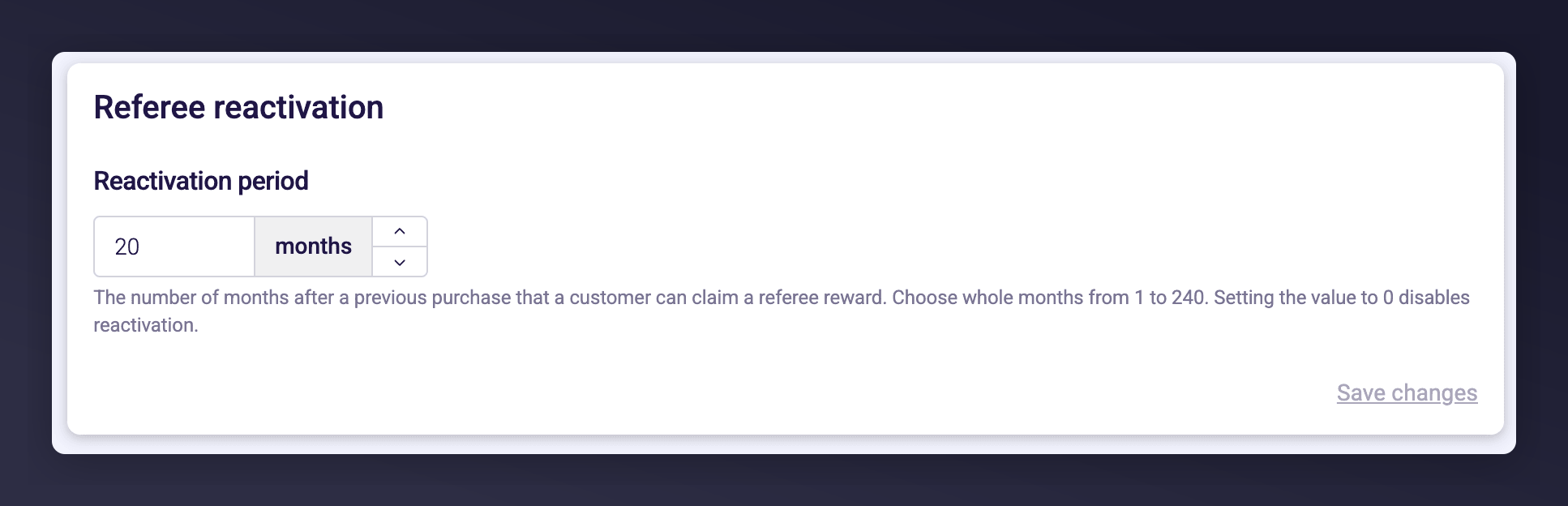
The Referee Reactivation settings page with the reactivation period field set to 20 months.