

Why Mention Me Might Ask You for More Vouchers
Mention Me sends automated alerts when a reward’s voucher supply needs attention, so you can top it up before it disrupts your customers’ rewards. We get in touch for one of three reasons:- Running low: your existing batch of voucher codes is nearly used up
- Expired or short validity: your current codes have expired, or are close to expiring
- Multi-use voucher issues: shared codes are running out quickly or carry a higher fraud risk
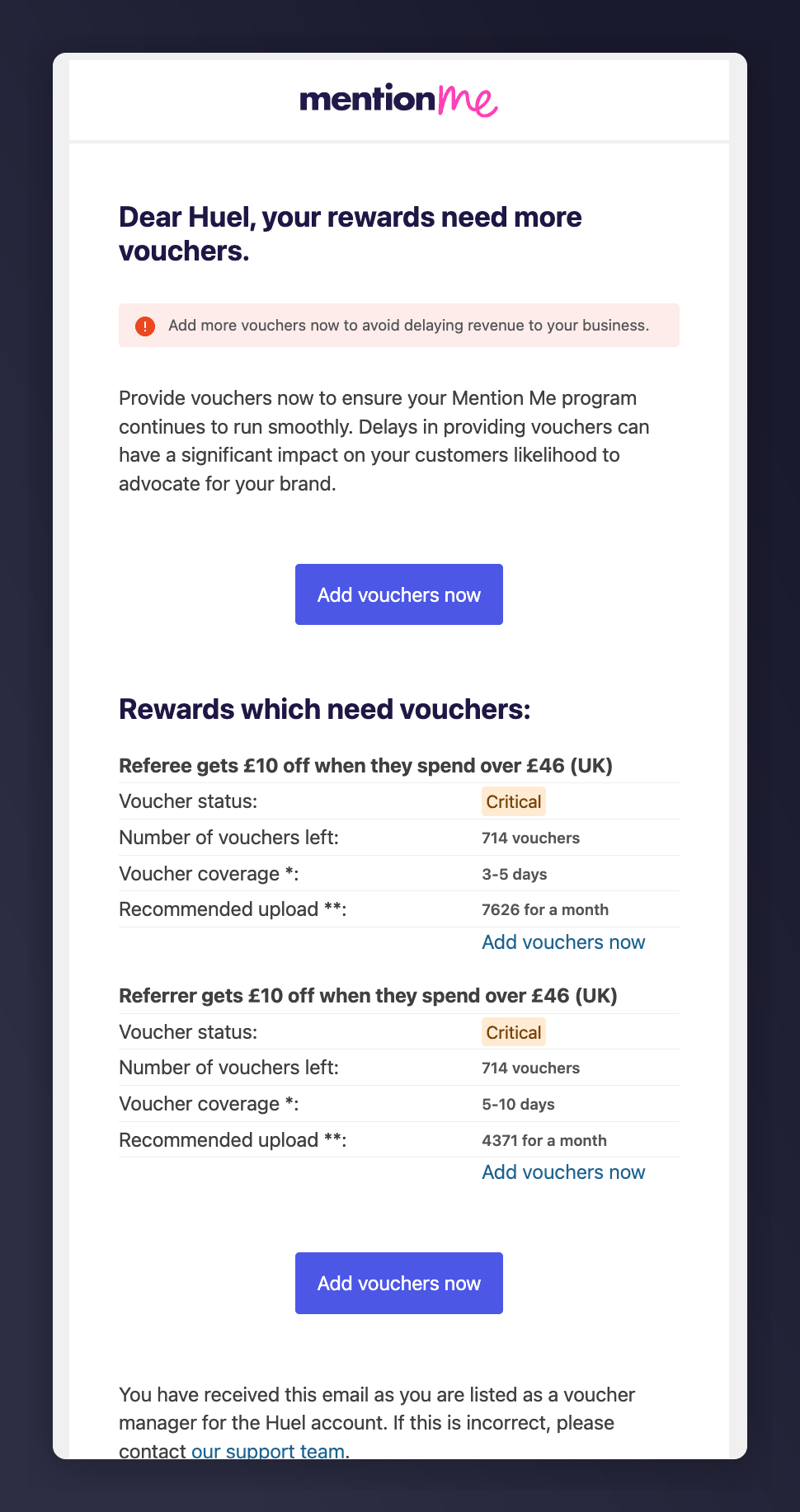
An automated alert email showing critical voucher status for referee and referrer rewards.
What Is a Voucher Validity Period?
The answer depends on perspective. From a customer’s point of view, voucher validity means how long they have to redeem their reward. From the platform’s point of view, it means how long the system is allowed to issue codes from a specific batch. Both the Referrer (the person sharing your offer) and the Referee (the person accepting it) are affected by these rules. To make sense of how validity works, it helps to split it into two distinct types:- Customer-facing validity: what the customer sees
- Platform validity: what happens behind the scenes in the referral system
Customer-Facing Validity
This is the validity period you promise to the customer: how long they have to use their voucher once it’s been issued. Think of it as a commitment, or a “promise period.” For example: “This voucher is valid for one month from the date of issue.” This promise applies to Referrers and Referees alike, and it’s what appears in your messaging, emails, and terms and conditions. This matters because if a customer tries to use their reward after the promised time limit, the code won’t work. Setting, and sticking to, a clear redemption window builds trust and improves the customer experience.Platform Validity
This is the timeframe during which the platform is allowed to issue vouchers from a specific batch. You set it when you upload your voucher codes. For example: you upload a batch of codes valid for distribution between 1 January and 31 December. That’s a platform validity of 12 months. This matters because a customer might earn a reward on 30 December, but if your customer-facing promise is “one month to redeem,” they need to be able to use their code until 30 January, which falls after the platform validity ends. Without careful planning, this can lead to a broken promise.How the Two Work Together
Platform validity must always account for customer-facing validity. Consider this scenario: today is 1 January, and your vouchers are promised to last for six months, but the end of their platform validity is set to 31 December. In that case, you cannot distribute these vouchers after 1 July. This is because a voucher issued on 1 July, plus its six-month promise, would extend beyond 1 January the following year, when the batch becomes invalid. Any voucher issued after that date would not give customers the full six months you promised. Customer-facing windows are often short (for example, 7 to 30 days), but platform validity typically spans much longer (for example, 6 to 12 months) to keep reward distribution running smoothly. You can check the current validity period for any campaign in the Mention Me platform. See How to Check Your Reward Validity Period for step-by-step instructions.Estimating How Many Voucher Codes to Upload
When you’re deciding how many codes to upload for your next batch, Mention Me can help you estimate demand. This estimate is based on:- How many codes you’ve uploaded previously
- How long that batch lasted before running out
- Your referrer reward’s validity period
Platform Distribution Period by Validity
Codes are assumed to have a 12-month life span by default. Because of this, your referrer reward validity period and the platform’s distribution period for that batch always add up to 12 months, so the longer your reward validity, the shorter the window the platform needs to distribute codes from that batch:Worked Examples
These examples show how we’d translate past voucher usage into a recommended upload for your next batch:- If you had 1,000 codes that lasted 6 months, we’d suggest raising your upload to 2,000 codes for a full 12-month cycle
- If 1,000 codes were used up in just 3 months, we’d suggest 4,000 codes next time
- If you provided 10,000 codes but only 5,000 were used, we’d suggest 5,000 codes for your next batch
Default Validity Assumptions
For most clients, Mention Me assumes your voucher codes are valid for 12 months unless you tell us otherwise.Amazon rewards are an exception to this default: they must remain valid for 10 years.
Multi-Use Vouchers
We recommend avoiding multi-use voucher codes where possible:- Fraud risk: a generic code such as “SUPERSALE15” can be shared widely with people who were never referred
- High depletion risk: a limited pool of uses means the code can run out quickly
Why Long-Life Vouchers Work Better
Where possible, use vouchers without an expiry date. Long-life vouchers offer several benefits:- Avoid needing frequent voucher uploads
- Prevent voucher expiry errors
- Create a better customer experience
- Reduce admin burden for your team
Key Takeaways
- Customer-facing validity is the time a customer has to redeem their voucher
- Platform validity is the time the system can issue a voucher to a successful Referrer or Referee
- Always make platform validity longer than customer-facing validity
- Upload codes with long life spans where possible
Need Help?
Start a conversation with the in-platform Support widget in the bottom-right corner of your dashboard - it can usually answer this straight away. If it can’t, raise a request via the request form.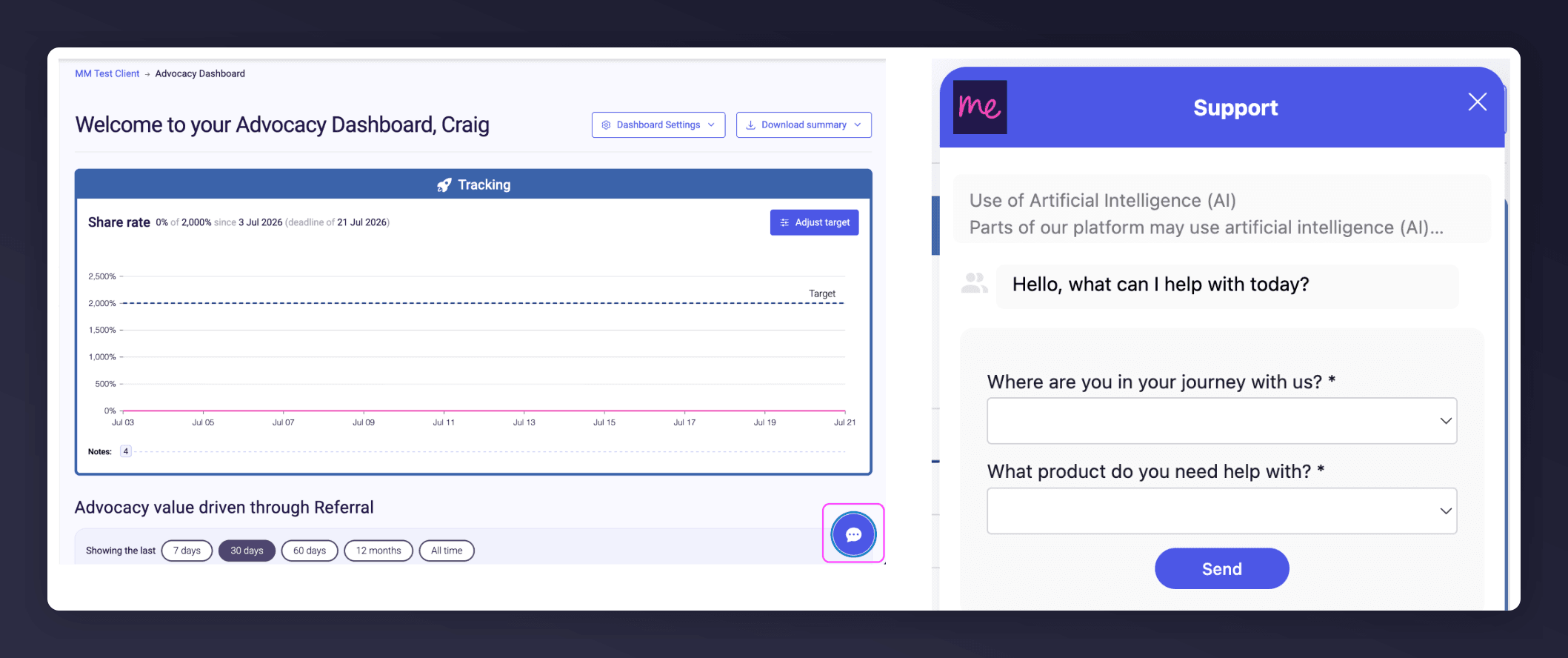
The in-platform Support widget starting an AI-assisted conversation.