

Five Compare Modes
Metric, chart (line or bar), and table tiles all support a Compare to setting:- Previous period. Compare against the same length of time immediately before the current one.
- Last week. Compare against the equivalent 7-day block a week ago.
- Last month. Compare against the equivalent month-long block a month ago.
- Last year. Compare against the same period a year earlier.
- Industry benchmark. Compare against the industry average for your category. Only shown when eligible (see below).
How Comparison Renders
On a metric tile, a small delta badge appears next to the value:+12.3% in green if the metric is up, -4.1% in red if it’s down. The comparison value sits beneath the main number.
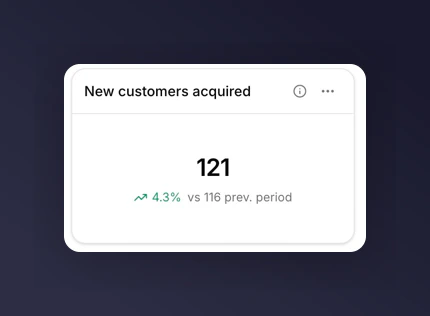
Metric tile with a comparison delta
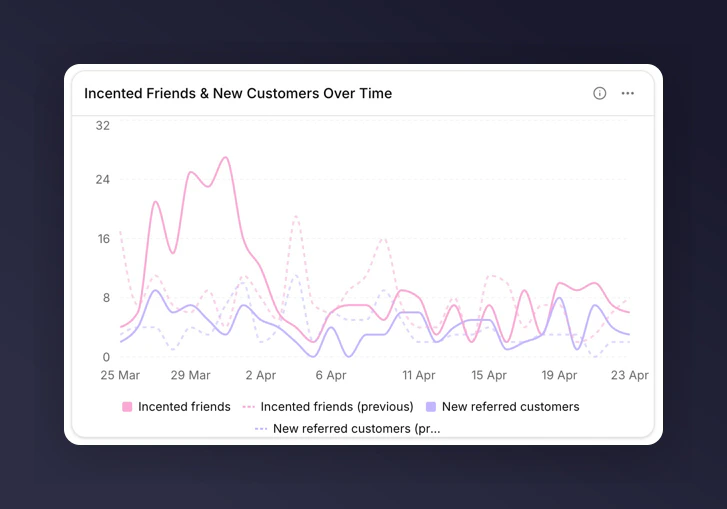
Line chart with a dashed compare line
Constraints
- Share, funnel, and stacked bar charts don’t support comparison. Switch the chart type to line or bar if you need it.
- Comparison and breakdown are mutually exclusive. Clear the breakdown to turn comparison on, or vice versa.
- On tables, setting a breakdown disables the compare column automatically.
Industry Benchmark
The Industry benchmark compare mode shows your tile’s metric alongside the industry benchmark for your category. When you hover a comparison point on a chart the tooltip reads “industry avg.” for that value.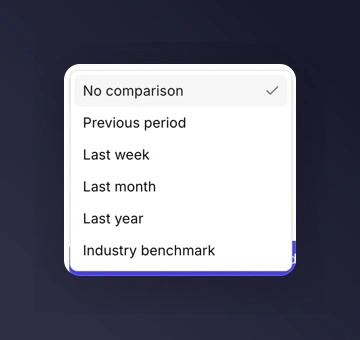
Industry benchmark option in the compare picker
Eligibility
Industry benchmark is available only when:- Your brand is in a category that has benchmark data available.
- The metric supports benchmark comparison.
- Enrolment Rate
- Share Rate
- Purchase Rate
- Impressions per Order
- Shares per Sharer
- Responses per Share
- Incented Friends per Share Response
- Purchases per Incented Friend
Next
Choosing a chart
See which chart types accept comparisons.
Metrics glossary
See which metrics are benchmark-eligible.