

For the concepts behind the two campaign types, and where holdouts fit, start with Understanding Brand and Product Referral. This page and the ones beside it cover how to set product referral up and run it.
Product Referral Versus Brand Referral
Understanding Brand and Product Referral covers why you would choose one over the other. The practical differences you will meet while setting a campaign up:How the Tracking Works
When a visitor lands on a product page, the Mention Me product tag gives them an anonymous visitor identifier and writes it into the page URL as anmm_rf parameter. If they copy that URL and a friend clicks it, Mention Me can connect the two visits. When either of them buys, the anonymous identifier is linked to a customer record and the order is attributed to the share.
No enrolment, sign-up or offer acceptance is involved, and nothing changes about how customers browse. For the technical detail of the tag itself, see the product referral tag documentation.
Product referral tracking depends on a live product referral campaign. The tag only injects the share link and rewrites the URL with
mm_rf while a campaign is live for that language, so a campaign is a prerequisite for attributing any sharing at all. See troubleshooting if sharing has stopped.The Two Campaign Modes
A product referral campaign runs in one of two modes:- Non-incentivised. Measures how customers share products and the orders their shares drive. No reward is offered to anyone. This is the default, and the fastest way to start.
- Incentivised. Shows an offer to the referred customer as soon as they land on the shared product page, and holds back a share of traffic as a control group so you can measure the difference the offer makes.
When the Offer Is Shown
On an incentivised campaign, the offer is served the moment a referred visitor lands on the shared product page, not after they buy. The sequence is:- A visitor arrives on a product page from a shared link.
- Mention Me checks they qualify: they came from a genuine share, and they are not the person who shared it.
- They are placed in either the offer group or the holdout, and that decision is remembered so a repeat visit gets the same answer.
- If they are in the offer group, their reward code is issued there and then and the offer is rendered on the page.
- They can apply it to the order they are already shopping for.
The setup wizard’s own wording for this mode reads “Reward referred customers when they buy a shared product”. That describes when the reward is earned, not when it is issued. The code is allocated at the point the visitor arrives.
One Campaign per Language
You can have exactly one product referral campaign per language, in either mode. If a language already has one, the setup flow sends you to it instead of creating a second. This is different from brand referral, where you can run many campaigns per language in parallel. A product referral campaign is a one-off setup per market, not something you author repeatedly.What a Product Referral Campaign Contains
The campaign editor tailors itself to the campaign type, so a product referral campaign shows a smaller set of nodes than a brand one. For how the canvas works, see the campaign editor.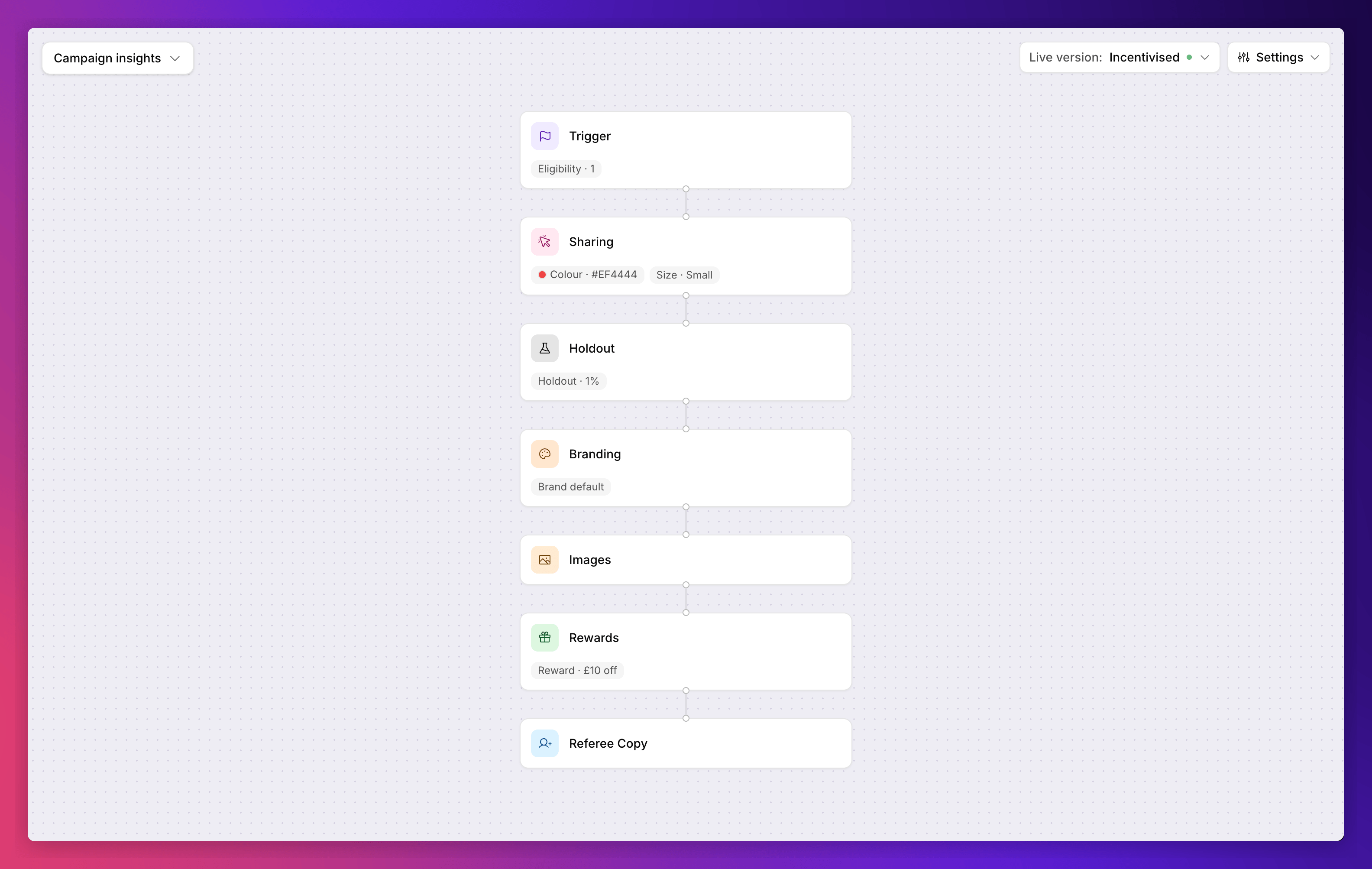
The campaign editor canvas on an incentivised product referral version.
A non-incentivised version has the Trigger and Sharing nodes and nothing else. With no incentive there is no offer shown to anyone, so the holdout, branding, imagery, reward and copy nodes all drop out. The share link stays, because the tag injects it whether or not the version carries an incentive.
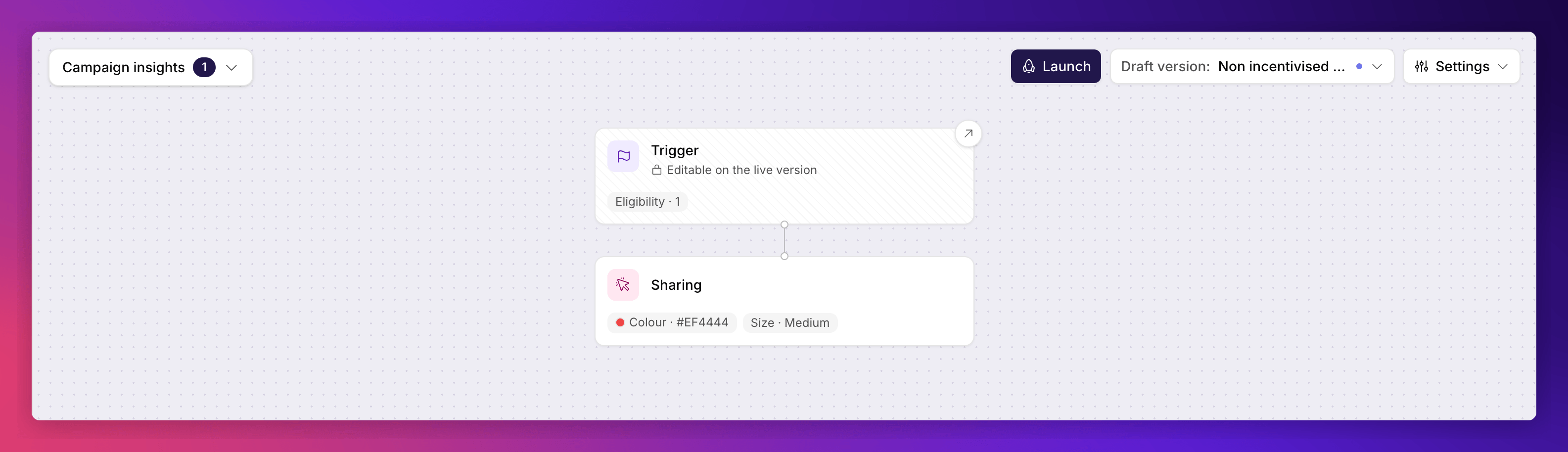
The campaign editor canvas on a non-incentivised product referral version.
What Brand Referral Has That Product Referral Doesn’t
A few things a brand referral campaign has work differently here, or are absent:- A referrer journey. There isn’t one. The sharer never leaves your product page, so there is no Referrer Copy node and no referrer reward.
- A/B testing is not offered. Product referral uses the holdout split instead, which answers a different question. See the holdout.
- Campaign settings exist, but they are a different set. Brand referral’s destination URLs, reply-to address and voucher options do not apply, because product referral has no referrer sharing and sends no email. In their place you get link tracking and UTM tagging. See tracking settings.
- Email imagery is not offered. There is no email anywhere in the product referral journey, so the Images node shows the Website tab alone.
- Fraud controls have no editing surface, because the protections are built into the campaign type rather than assembled from rules. Every referred arrival is checked automatically: it must have come from a genuine share, and self-referral is blocked, both when the visitor arrives and again against their email address once an order is placed. There is nothing to switch on or tune.
- Duplicating the campaign is not possible. Only one product referral campaign may exist per language, so new work is a new version inside the existing campaign.
Trigger Conditions Are Restricted
A product referral campaign is matched from the product page tag, before anyone has identified themselves and before there is an order. Conditions that need order or customer context could never be evaluated, so the picker offers Customer details conditions only, and within those only the six a product page view can answer: Currency, Custom data, Segment, Locale, Implementation and Situation. With a single category on offer, the picker flattens: there is no Recommended group and no category to drill into. Not offered: Order value, Order ID and Coupon code, which describe an order that does not exist yet, and Customer ID, Email address, City and Country, which describe an identified customer, while the sharer on a product page is anonymous. Every other category (customer history, past segments, gender, NPS and so on) is out for the same reason. Any rule already saved on a campaign still shows and can still be removed, whatever it checks. There is also no Qualifying purchases section, because a product referral campaign has no referee purchase to qualify. The left nav keeps its frame, with Eligibility as the only entry.What Is Not Available Yet
Also not yet available:- Per-campaign performance figures. The product referral list carries no metric columns, and the campaign insights panel says performance will appear there soon.
See Also
Set up a campaign
Create your first product referral campaign.
Campaign modes
Non-incentivised and incentivised, and how to move between them.
The share link
Customise the share link on your product pages.
Product referral tag
The technical integration for your product pages.
Brand and product referral
The concepts behind the two campaign types.